
Osprey Fairview & Farpoint 65 Review: Is It Still the Best Wheeled Travel Pack? (2026 Update)
This post may contain affiliate links, meaning we get a commission if you decide to purchase through our links at no cost to you. This helps fund Slower Travels without costing you a cent!
We spent some time deciding what type of luggage to buy while planning our digital nomad adventure. Wheels or no wheels? Straps or no straps? Does it need a hard shell? Cheap or expensive? Here’s a breakdown of our decision-making process, the luggage we chose, and how it turned out. I hope this makes your leap into the world of digital nomadism a little easier.
Best Luggage for Digital Nomads
The first question was whether to get suitcases or backpacks. We were likely to board small boats from the beach in Thailand, walk along cobbled streets in Europe, and climb flights of stairs in Soviet-era apartment buildings in Vietnam. But alongside that, wheels are so nice to have. Because sometimes you’re not adventuring in the wilderness. You’re just wheeling it around an airport or down the road to the bus station. Ideally, we wanted something that worked wherever we were. We’re not trying to be minimalists and only travel with a carry-on. We’re also planning on doing this for a long time, so we wanted luggage that would make our travels as comfortable as possible.
The next priority was quality. We were hitting the road full-time, indefinitely, so having something that would last was a significant factor. This led us to Osprey. They know their stuff when it comes to packs that can handle the great outdoors. We were going to be more on the well-beaten path than in the backcountry, but wanted luggage that was well-made and wouldn’t need to be replaced all the time. The slow travel mindset we adopted applies to what we buy as well.
In the end, we went with the Fairview (for women) and Farpoint (for men) 65L packs from Osprey. Yes, we have matching luggage. Once we knew what we wanted, we waited until Black Friday sales and got them at 50% off. Winning.
So what do we think now that we’ve got them and have been using them?

Overall Look and Feel
I love the look of the bags themselves. I think people are equally surprised when we pull out the handle to tow them or whip out the straps to carry them. They don’t look exactly like a suitcase or a backpack.
The bags are identical except for a little strap green and teal to tell them apart. My one wish was that we were able to actually purchase different colours when we bought them. I’ve seen older versions of this bag in multiple colours so I’m sure there are other options out there in some stores.
My bag did go missing briefly on a flight and I wondered what I would do if I had a replace it. I decided that I hadn’t seen anything else that looked as good or functioned as well. If I had to get a new bag, I would’ve got the exact same one.

Reunited with my bag after it got lost on a flight.
A Note on Fit: Fairview vs Farpoint Has Changed
When we bought ours, Osprey sold this pack as two distinct fits: the Fairview, built for smaller frames with a curved harness and higher-sitting hip belt, and the Farpoint, with straighter, broader straps suited to a typical man's torso. We chose based on fit, not gender, and it made a real difference to comfort over long days of wear.
Osprey has since moved to a single unisex fit for this wheeled 65L pack, now priced at $350 USD. If you're petite or have a shorter torso, it's worth trying it on or checking the size chart carefully before buying, since you won't have the option to choose the more curved harness we did. If a closer fit matters to you, it may be worth comparing harness shapes on Osprey's smaller daypack-only Fairview/Farpoint models, which still use gendered names, before committing to the larger wheeled pack.
The 65L capacity, the wheels, the detachable daypack, and the build quality all remain the same as what we've been using.
Size and Weight
When our bags were delivered, I was a little concerned. How was I going to pack everything I owned into that one small bag? But now we’re on the road, they seem like the perfect size. When we left, they were up around 44 lbs (20 kg) when full and a little tightly packed. Now we’ve got around 33 lbs each (15 kgs), and they’re easy to manoeuvre or carry.
The bags themselves weigh around 6 lbs (less than 3kgs), which is always important when you’re trying to keep the overall weight down. And the size is 65L, which is big enough for us to pack everything we own and survive comfortably on the road.

Durability
The quality is definitely worth it. We’ve dragged them over stone paths, into jungles, up stairs and along boardwalks, not to mention the 30+ flights they’ve been on, and they’re not showing any signs of wear. Yes, paying for quality can be hard on the budget, but not having to replace our bags constantly because they’re falling apart will save us in the long run.
Compartments and Organisation
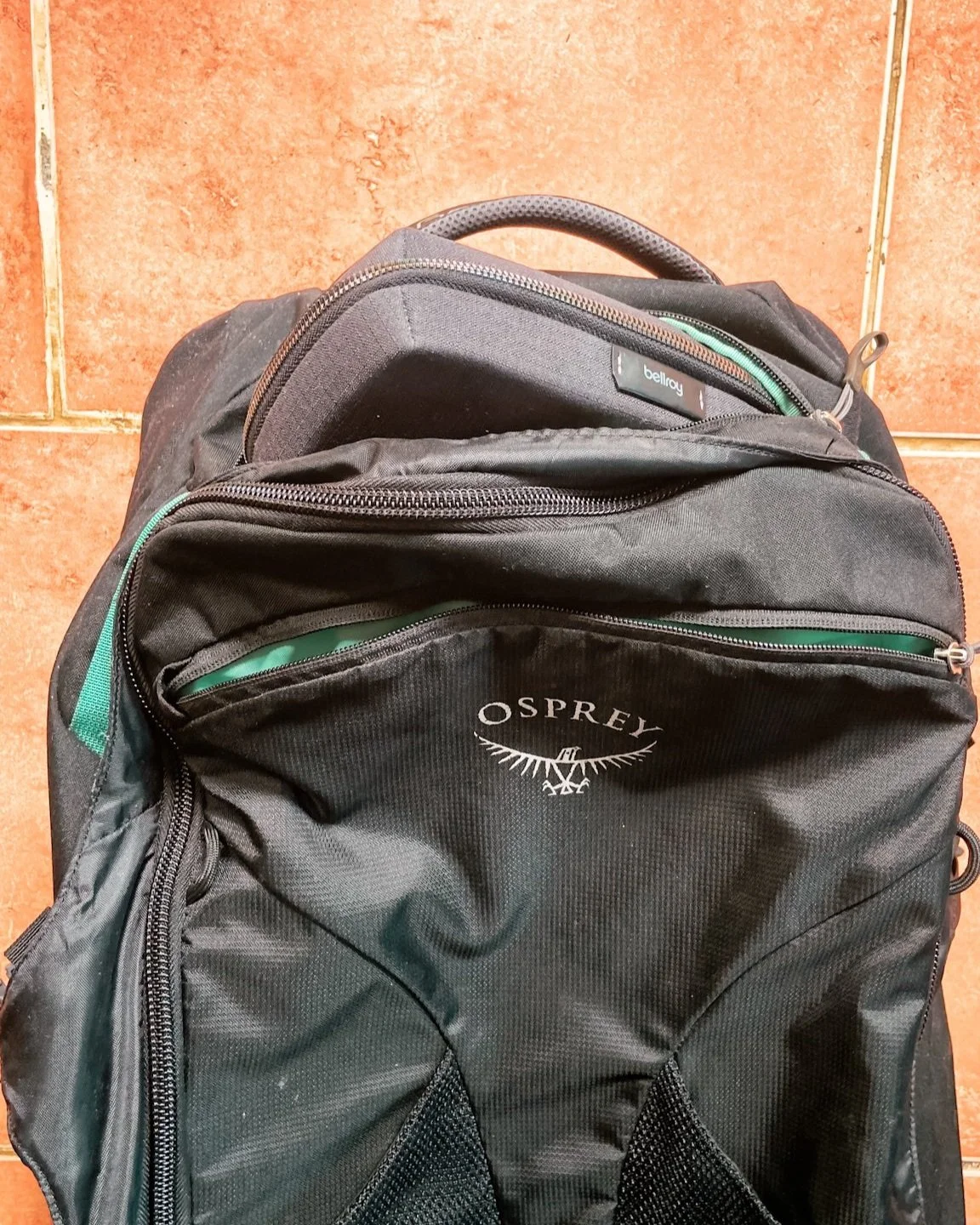
To keep the bags light, they are simple. There is one main compartment with a double zipper that runs all the way around and opens like a suitcase. No digging in from the top of the bag trying to find that one item that’s slipped to the bottom. On the inside of the opening, there are two mesh compartments for small bits and pieces.
There is also one small compartment on the top of the bag. Kieron uses this for his toiletries, and Tania uses it to stash all the items she realises she forgot to pack once the bag is all zipped up. On the outside, there are two mesh pockets which are the perfect size for your flip-flops. Then Tania uses the outside straps to attach her yoga mat to the bag. It’s survived multiple flights this way and fingers are crossed that continues.


As a Backpack
The packs are comfortable to wear as Osprey actually knows what they’re doing in this department. The straps are padded so they don't dig in like a cheap backpack. The support works well, evenly distributing the weight across your shoulders and around your hips.
Switching from one function to another only takes a moment. The back panel has two long zippers that lift a flap that conceals all the straps when in suitcase mode. Roll up this strip of fabric, and you’re ready to go. A speedy transition is helpful when you’re not sure what you’ll encounter in a new place.

As a Wheeled Bag
This is how we’ve mostly used the bags so far. And they’ve been great. There are two small wheels, but they have been super durable as we’ve pulled them around seven countries for nine months so far. They’re not the more modern design of four wheels, so if you’re towing it a long way, it is going to pull down on your arm. But it’s never been an issue for us.
The only downside to these bags is that there is a single retractable arm, rather than the usual two, which creates a loop like the one on a suitcase. This can make it a little unwieldy and likely to tip over when towing. This only really happens if something is in the way of the bag, so we’ve just adapted and are a little more careful about where we walk to prevent it. I’m presuming this is a design feature to save weight or is related to the backpack's structure. All up, the slight inconvenience is worth it for the dual purpose.

Who Should (and Shouldn't) Buy This Pack
This pack makes sense if:
You want one bag that works as both checked luggage and a backpack, without having to own two separate pieces.
You're travelling long-term or full-time, where durability matters more than shaving off the last few hundred grams.
You're moving between cities, transport hubs, and the occasional rough path. We’re talking pavement and platforms more than backcountry trails.
You'd rather pay once for something built to last than replace a cheaper bag every year or two.
It's probably not for you if:
You're after an ultralight, minimalist carry-on-only setup. At 65L and around 3kg empty, this isn't built for that.
You need true four-wheel manoeuvrability for long airport transfers; the single retractable handle and two wheels work, but they're not as effortless as a proper spinner suitcase.
You want a wide choice of colours. Availability has been limited to one or two options, depending on when and where you buy.
| Pros | Cons |
|---|---|
| Genuinely dual-purpose — works as backpack or wheeled bag | Only two wheels, not four, so longer tows pull on your arm |
| Built to last; ours show no wear after 100+ flights and four years on the road | Single retractable handle can make the bag flip if towed awkwardly |
| Now a single, simplified fit — easier to shop, though less tailored than the old Fairview/Farpoint split | Limited colour availability at time of purchase |
| Smart organisation — mesh pockets, top stash compartment, lockable zips | No included rain cover |
| Detachable daypack adds flexibility for day trips | At 65L and $350, it's a serious investment, not for minimalist or carry-on-only travellers |
Final review
If you’re looking for new luggage and you want something that works as well when being towed along a railway platform as it does when being hiked up a cobblestone street, we can’t recommend the Osprey Fairview and Farpoint enough. We love owning them and would definitely buy them again if we needed new luggage.
If this sounds like the kind of bag that'll keep up with how you actually travel, you can check current pricing, colours, and availability on Osprey's site. And if you've got a wheeled pack of your own, let us know in the comments whether you love it, hate it, or are still deciding. We're always curious how other long-term travellers pack.


There are four run clubs and a walk club operating in Kuta, Lombok. Here's the full guide to days, start times, and how to get involved.