
Saily eSIM Review 2026: Tested in Indonesia, Thailand & Malaysia
Updated for 2026 with new pricing, regional plans, Indonesia restrictions insight + fresh comparison across eSIM providers.
This post may contain affiliate links, meaning we get a commission if you decide to purchase through our links at no cost to you. This helps fund Slower Travels without costing you a cent!
Staying connected while travelling in Southeast Asia can be… a lot.
Take SIM card registration in Indonesia, for example. The government has tightened phone registration rules, and depending on your handset, you may need to register the IMEI on arrival — a process that involves paperwork, a queue, and (if you’re me) at least one moment of thinking, surely there’s an easier way to do this.
My breaking point came recently in Lombok. I walked into a tiny mobile shop where the sweetest girl tried so hard to help me get a physical SIM to register. She didn’t speak English; I didn’t have data to open Google Translate. After 20 minutes of smiling, sweating, removing my SIM tray with a paperclip, reinserting it, and trying every combination known to humankind… I gave up. Walked back to my villa. Connected to WiFi. Bought an eSIM. Went out for a mango juice.
This is honestly the story behind why I keep Saily installed on my phone: not because it’s the cheapest in the world, but because it works without drama.
On a recent trip to Bangkok, I downloaded my last eSIM while eating my first (of many) cheese toasties of the trip, sitting on the ground outside 7-Eleven at the airport. If you know, you know.
Here’s the full review (updated for travelling in 2026) with new pricing, plan comparisons, alternatives, and exactly when I think Saily performs best.

What is Saily eSIM?
Saily eSIM was launched in 2024 by NordVPN. NordVPN is a reliable service, which helped me put faith in their new eSIM product.
This new eSIM is available in 150 countries, so they probably have you covered no matter where you travel!
What is an eSIM?
First things first, what exactly is an eSIM?
eSIM stands for embedded SIM, which allows you to use cellular data from your device without needing a physical SIM card. When travelling, this can be a lifesaver because you don’t need to find a store or negotiate local complications of signing up. Some countries do make this complicated!
Most companies offer this through an app on your phone. You download the app, purchase your plan, and you’re ready. It's a much more simplified process, as anyone who’s tried to purchase a SIM overseas can tell you.
Pros of Saily’s eSIM:
Locations. If you’re a frequent traveller, you don’t want to have to find a new eSIM provider for each country or region you visit. Instead, Saily is available in over 150 countries, simplifying your life.
Easy to use. No one wants to learn to use a complicated system to save a few dollars. The Saily app, available for iOS and Android, is intuitive and quick to set up.
Pricing. Roaming fees can be extortionate. Skip the hefty phone bills and keep scrolling on the go.
Support. I didn’t need additional support when I set up my Saily account, but I’ve heard good reports about how responsive the team is.
Hotspot. Working on the go? Don’t get stuck with a SIM that doesn’t allow you to hotspot. A Saily eSIM has you covered.
Trusted Brand. Plenty of small eSIM brands are popping up, but going with a big player, like Saily’s parent company, NordVPN, brings peace of mind.
Wifi on arrival. Having reliable connectivity as soon as you land and until you sort out a local option can bring peace of mind. eSIMs can be a great temporary solution when landing in a new country.
Cons of Saily’s eSIM:
Cost. If you’re in a country for more than a few days, purchasing a local SIM card may be more cost-effective.
Limited functionality. Yes, you’ll have data, but you won’t be able to make calls or send texts. But who does that these days anyway?
Saily eSIM Data Plans:
When choosing your data plan, you need to consider two variables: size and number of days. These increase together, with small packages only valid for a day. Larger packages can be available for up to 180 days.
First, you want to consider the length of your trip. Even if you have data left, you won’t be able to use it if you're over your allocated timeframe.
This can be frustrating if you know you’ll mostly be on wifi but want a small amount of data that is always available for emergencies. You must still purchase a large package to access the data for a more extended trip.
You can only do the initial setup to access your data when Wi-Fi is available. So, if you purchase a plan as a backup, you might be unable to switch it on.
Various plans allow travellers to select the option that best suits their travel plans. However, if you need a large amount of data, you may need to look at local options for better prices.
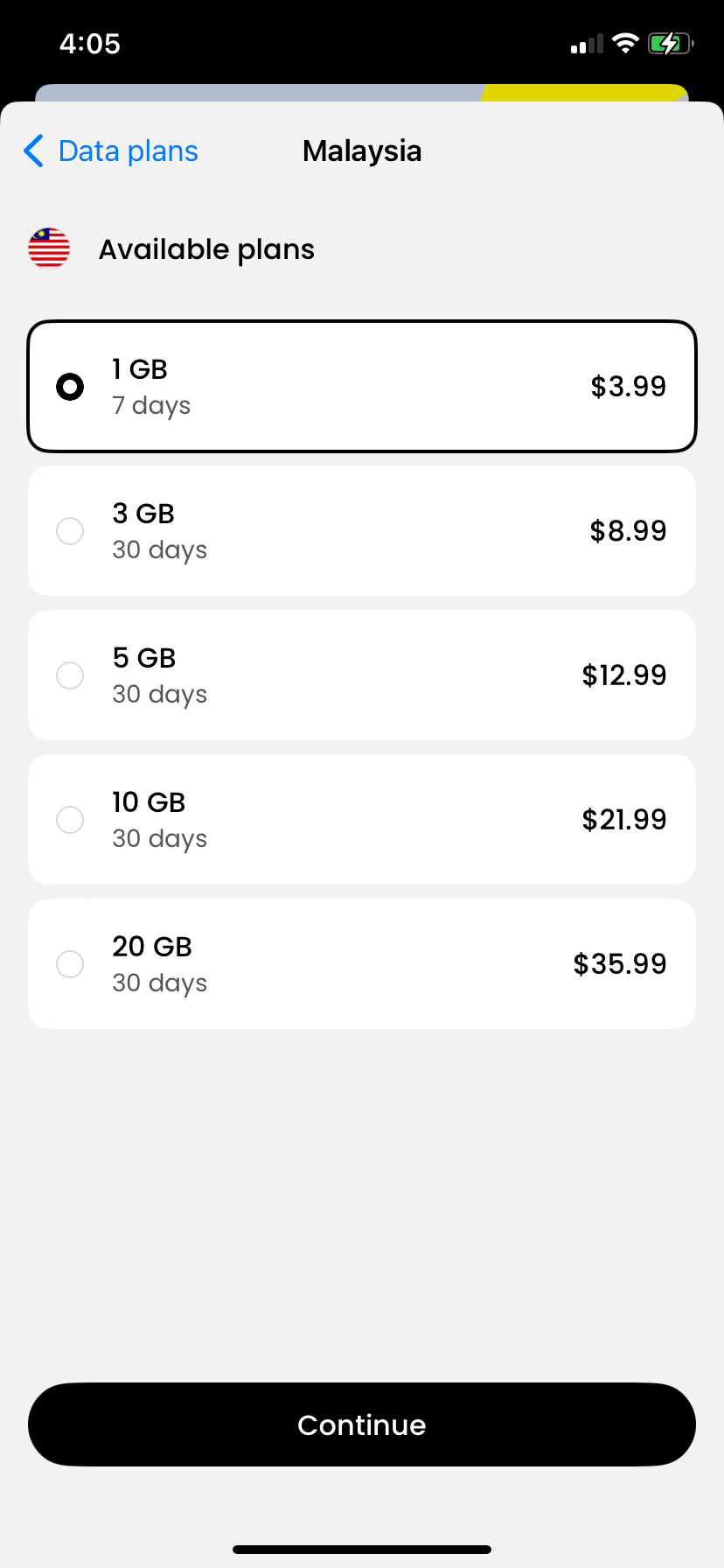
Saily eSIM options for Malaysia
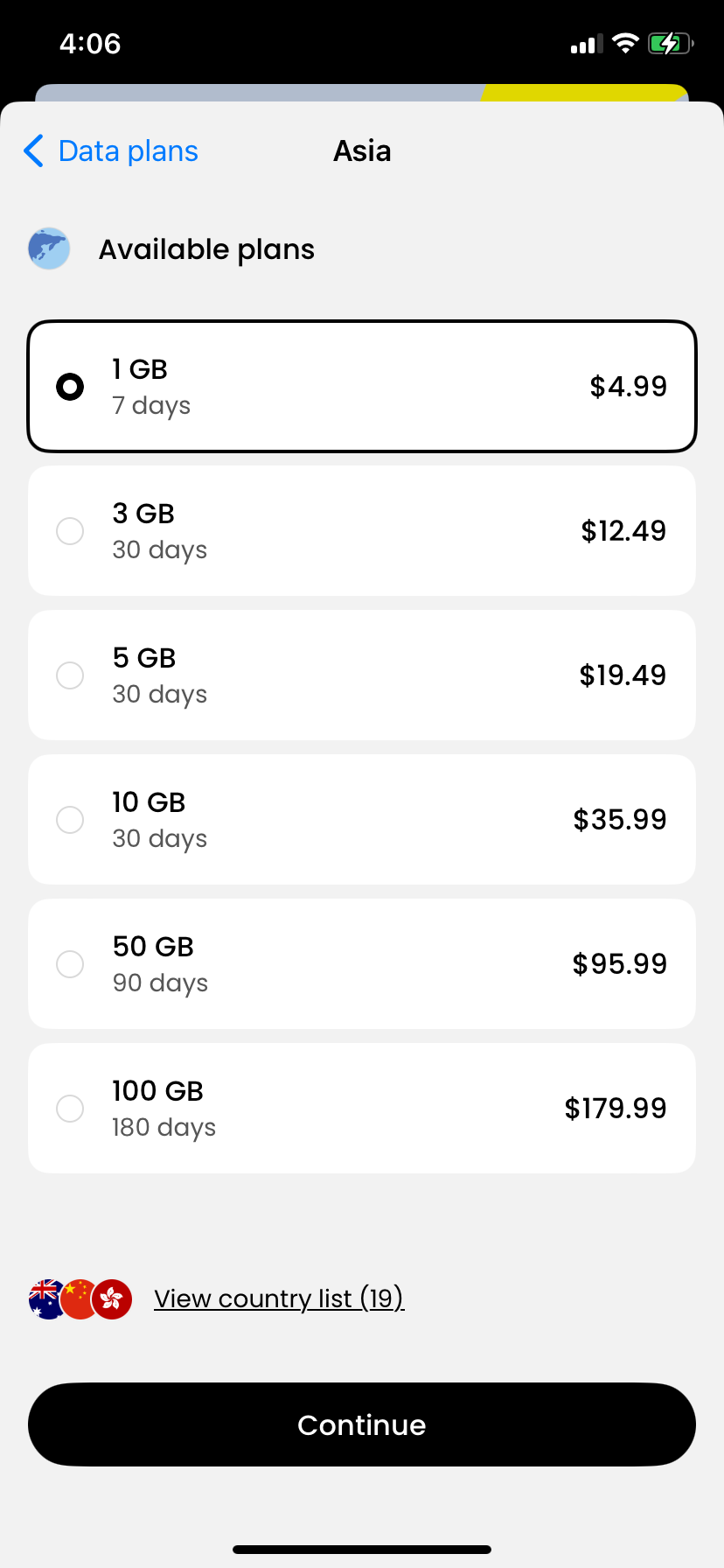
Saily eSIM options for Asia
Saily eSIM Packages Coverage
Saily offers three different types of packages, depending on what sort of trip you’re taking.
Local eSIM. These are valid for use in a specific country. These are ideal if you have a stopover for a few days on your way to your final destination. You can buy them in various allowance sizes depending on how much you’re likely to need so you can tailor it to your trip.
Regional eSIM. These are great if you’re hopping through a few countries in a specific region, e.g. Asia, Africa or the Middle East. Rather than having to organise a new SIM in each country and work out how much data you need each time, buy a single package to cover you for the whole trip.
Global eSIM. Bouncing around the entire globe? You can purchase a package for multiple continents to cover the entire trip.
Travelling Around Southeast Asia? A Regional eSIM Is Usually Cheaper
If you’re bouncing around Southeast Asia — Bangkok today, Bali tomorrow, and somewhere with really good noodles after that — you’ll almost always save money with a regional eSIM instead of buying country by country.
These are the ones I personally use:
Saily Southeast Asia (simple & reliable)
Airalo Discover SEA (great value)
Holafly SEA (unlimited data options)
These are affiliate links, which cost you nothing extra but help me keep this blog running — and keep me caffeinated enough to test eSIMs in airports so you don’t have to.
Saily eSIM Pricing
Pricing is a crucial factor when considering eSIM or SIM options.
From my travels, I have found that if you travel slowly (which I always recommend!), there are sometimes better answers than an eSIM.
For many Southeast Asian countries, you can purchase a local SIM card and load it with a data package. Vendors at airport arrivals and in most towns offer this service.
However, an eSIM offers a cost-effective option if you have a short stopover.
Before departing, I would always research some local providers and compare their packages with an eSIM option. Alternatively, you can do this at the airport if you have wifi available when you land.
Saily’s prices are very reasonable, starting at $3.99 USD. However, there are regional differences in what Saily offers. For example, 1GB in Asia is just $4.99 USD, but in Barbados, the same package is $8.99 USD. Before purchasing, review all the options available for your itinerary and plan accordingly.
Remember, though, you’re paying for convenience. Even if an eSIM is more expensive, it may be worth it for peace of mind, especially if you plan to purchase a local SIM later.
2026 Pricing
Saily’s pricing has shifted slightly in the last year, so I’ve updated the plans below. As always, prices can change — especially for regional bundles — so I’m linking directly to Saily’s official pages above so you can quickly cross-check before travelling.
In general, Saily sits in the “affordable but not always the cheapest” category. Some providers (like Airalo) regularly beat them on price, but Saily tends to have more generous expiry windows and a very simple app that just… works. When you’re jet-lagged and half-functioning, this matters.
Global eSIM Plans
| Data | Validity | Price (USD) |
|---|---|---|
| 1 GB | 7 days | $8.99 |
| 2 GB | 15 days | $16.49 |
| 5 GB | 60 days | $33.99 |
| 10 GB | 180 days | $56.99 |
| 20 GB | 365 days | $66.99 |
Asia & Oceania Regional Plans
| Data | Validity | Price (USD) |
|---|---|---|
| 1 GB | 7 days | $4.99 |
| 3 GB | 30 days | $12.49 |
| 5 GB | 30 days | $19.49 |
| 10 GB | 30 days | $35.99 |
| 25 GB | 60 days | $48.99 |
| 100 GB | 180 days | $179.99 |
🇮🇩 Indonesia Plans
| Data | Validity | Price (USD) |
|---|---|---|
| 1 GB | 7 days | $4.79 |
| 3 GB | 30 days | $8.99 |
| 5 GB | 30 days | $13.99 |
| 10 GB | 30 days | $21.99 |
| 20 GB | 30 days | $35.99 |
| Unlimited | 15 days | $48.99 |
🇹🇭 Thailand Plans
| Data | Validity | Price (USD) |
|---|---|---|
| 1 GB | 7 days | $2.99 |
| 3 GB | 30 days | $5.99 |
| 5 GB | 30 days | $7.99 |
| 10 GB | 30 days | $10.99 |
| 20 GB | 30 days | $19.99 |
| Unlimited | 15 days | $48.99 |
Includes: Australia, China, Hong Kong, India, Indonesia, Japan, Kazakhstan, Macau, Malaysia, New Zealand, Pakistan, Philippines, Singapore, South Korea, Sri Lanka, Taiwan, Thailand, Uzbekistan, Vietnam.
Saily’s Operators, Coverage and Data Speeds
As you’re not purchasing directly from a local provider, the details of your service will vary depending on Saily's regional partners. You may want to research your specific destination before making a decision. Just because Saily provides coverage in a particular country doesn’t mean it will be reliable.
I can confirm that I have never had any issues with coverage or speed throttling in Malaysia.
Although Saily offers a range of networks from LTE up to 5G, the availability of services will depend on your destination. Remember too, Saily won’t allow you to make or receive calls or texts.
Additional Features
Here’s a list of a few additional features of the Saily eSIM.
Data Management. Knowing how much data you have left is important. You don’t want to run out before your trip is up. The Saily app clearly shows how much data you’ve used so you can manage your usage.
Customer Support. This is key to any service. All the reviews I’ve read have said that they provide excellent service. I found their service simple, and I didn’t have any issues with my purchase, so I didn’t have a chance to use their customer support functions.
Setup Guides. The first attempt to install my credit didn’t work, so I did refer to their setup guides. These are clearly laid out and quickly helped me work out what I was doing wrong so I could access my data.
eSIM Competitor Comparison
Airalo
Airalo is probably the best-known eSIM brand and it’s the one that gets recommended constantly in travel Facebook groups and forums. Their prices are usually very competitive, and they have a huge range of country and regional packs, which is why so many travellers start there. I’ve had an installation fail on me once, so I don’t personally rely on it anymore, but most people I meet on the road still swear by Airalo as their default.
Holafly
Holafly is the “unlimited data” option, which can be a lifesaver if you’re a heavy user or working online while you travel. You pay more for that convenience and speeds can slow a bit at busy times, but it’s very reassuring knowing you’re unlikely to run out of data. I’m using it at the moment and it’s by far the most hands-off in terms of thinking about gigabytes.
Nomad
I haven’t personally used Nomad yet, but it comes up a lot in recommendations from other long-term travellers. It’s generally praised for strong speeds and solid coverage in popular destinations like Thailand and Vietnam. If you like to test a few different apps to see what works best for your route, Nomad is one worth having on your phone.
MossRoam
I truly wanted to like MossRoam. But in practice, it just didn’t perform well for me. The pricing was on the higher side, and the speeds were unreliable enough that I ended up switching to another provider mid-trip.
JetPack
JetPack was a complete misfire for me. The eSIM wouldn't activate even though I was already in the country, and the support staff weren’t helpful. After a couple of attempts, I abandoned it and moved on — a perfect example of why backup eSIM apps are essential.
Saily
Saily hits the middle ground: it’s not always the cheapest or the fastest, but it’s consistently easy. The app is clean, installation is painless, and it’s the one I reach for when I don’t have the capacity to troubleshoot yet another provider. For Indonesia in particular — with IMEI restrictions and SIM registration rules — it removes so much friction.
Saily eSIM in Thailand
We recently spent a month in Bangkok. We were arriving in the middle of the night and I knew we’d be tired and not want to sort out our SIMs at the airport. I also knew we didn’t want to be wandering around the next morning without data. Even though this wasn’t going to be a quick Bangkok stopover, we still opted for eSIMs.
And I’m so glad we did. We paid for the planes while we were waiting to board. We used the airport wifi to set everything up once we arrived and were waiting for our bags. The data for the month was extremely affordable.
It worked perfectly for us in Bangkok, no black spots. It also worked for us when we travelled to Ayutthaya by train and spent the day wandering around the temples. It's very necessary to order taxis to get around up there.
A Quick Note: A VPN Will Save Your Sanity in Southeast Asia
If you’re travelling for more than a couple of weeks, a VPN quietly becomes one of your most useful tools.
It keeps your banking apps working, protects you on airport WiFi (which is… chaotic), and stops Netflix from switching you to the random local catalogue just because you opened the app in a Thai café.
I use NordVPN. It’s the only one that hasn’t let me down in Indonesia.
Summary
For me, an eSIM isn’t about being trendy or “digital nomad-y”. It’s about feeling confident the moment I touch down somewhere unfamiliar. As a woman who sometimes travels alone, that first hour in a new country matters — finding the right exit, booking a safe ride, checking a map, and messaging someone to let them know I’ve landed. An eSIM removes the wobble from those moments.
It also makes stopovers and short trips so much easier. You don’t need to hunt down a kiosk, navigate language barriers, or register your phone with a government system that may or may not be open on weekends. You land, connect, and go.
In places like Indonesia, where getting a physical SIM can involve IMEI registration or long lines, having an eSIM ready gives you instant breathing room. It means you can get to your accommodation, get settled, get water, get food — without the stress of sorting admin while jet-lagged.
I’ve found Saily to be one of the easiest, most dependable options I’ve used. If you value simplicity, safety, and a smooth first hour in a new place, an eSIM like Saily is absolutely worth it.




There are four run clubs and a walk club operating in Kuta, Lombok. Here's the full guide to days, start times, and how to get involved.